Description
Alphabet knowledge is crucial for early literacy development as it provides the foundation for reading and writing by enabling children to recognize letter shapes, names, and their corresponding sounds. This is essential for decoding words, spelling as well as being a building block to reading.
Being able to identify lowercase and uppercase letters allows children to recognize the difference in formation as well as to understand the meaning – lowercase letters are used more commonly and uppercase letters as used for proper nouns, the starting of a sentence etc.
Sorting and matching helps develop visual perceptual skills, critical thinking as well as memory skills. These important brain skills help with attention and problem-solving.
The goal of alphabet matching is to enhance letter recognition skills, which is crucial for reading and writing development.
How to Wonder & Bloom
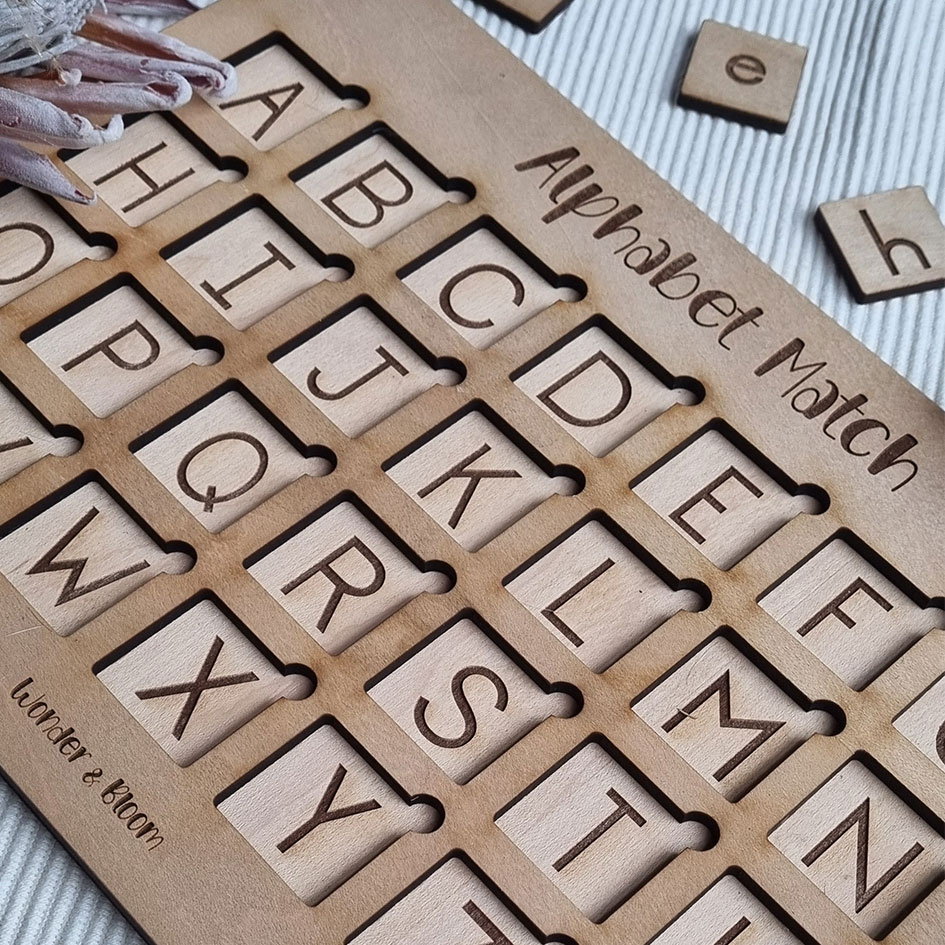
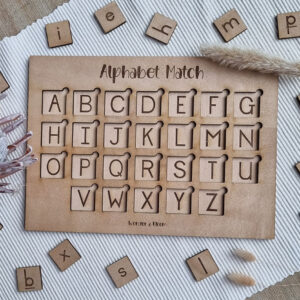
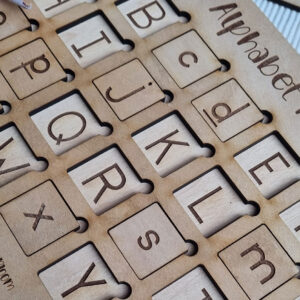
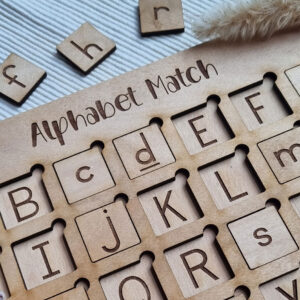
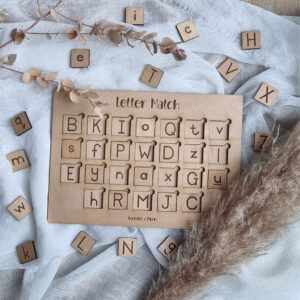
Place your Bloom Board in front of you. Place the wooden tiles face-up in an area where all the letters are visible. Now simply match the uppercase letter to it’s corresponding lowercase letter. As you match the letter, say it’s name and sound.
Extension options:
*Turn all the tiles over and mix them around. Turn the tiles one-by-one and find its corresponding letter.
*Time yourself and see how fast you can complete your alphabet puzzle
*Get someone to say random letters out loud and see how quickly you can find and match the letter.
What is Included
1 x Natural Wood Bloom Board
1 x Full Alphabet (26 wooden engraved tiles)
Board Size: 20cm x 28cm
Please note that all of our Bloom Boards are made from natural, locally sourced wood. Due to the inherent characteristics of the material, variations in colour, grain and texture are to be expected.
Educational Benefits
Educational Benefits of Wonder & Bloom Boards Include:
Multi-Sensory Learning: Wooden activities engage multiple senses, which helps children grasp and retain concepts more effectively.
Focus and Patience: The tactile nature of wooden activities promotes concentration and patience, especially when solving problems or completing tasks.
Fine Motor Skills: Manipulating wooden pieces helps develop dexterity and hand-eye coordination, both important for writing and physical tasks.
Communication skills: Children actively engage in language use and communication, which helps develop emotional expression, conversational abilities and social skills.
These wooden activities combine fun and hands-on learning, allowing children to grasp simple and complex concepts in English and Math in an engaging and effective way.






Reviews
There are no reviews yet.